Meta AI Sweeps STEM Olympiads With Perfect Scores
Meta AI has achieved perfect scores and gold medals across five prestigious STEM Olympiads using pure internal reasoning, proving that models can solve novel, complex problems without tools.
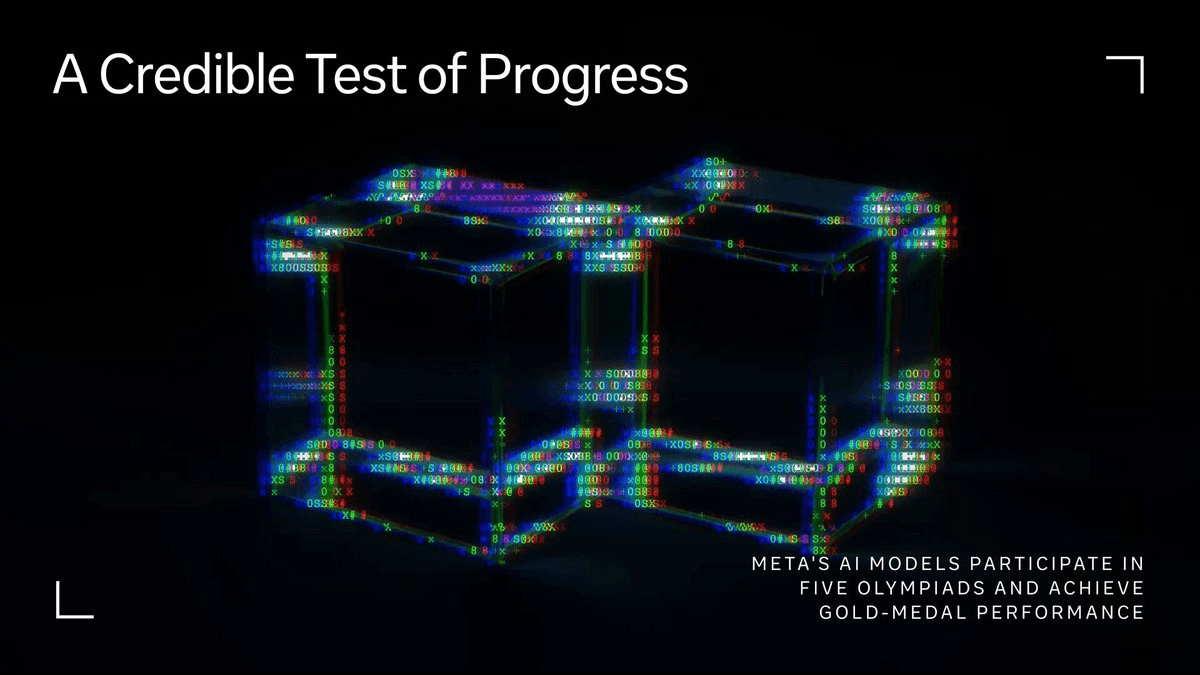
Meta AI recently announced that its artificial intelligence models competed in five elite international STEM Olympiads, securing gold medals and perfect scores. The AI achieved flawless results on the theory examinations of both the Asian Physics Olympiad (APhO) and the International Physics Olympiad (IPhO). Additionally, it secured a gold medal at the International Mathematical Olympiad (IMO), alongside gold-level performances at the International Chemistry Olympiad (IChO) and the Romanian Masters of Mathematics (RMM).
What makes these achievements particularly notable is that the models operated under a strict zero-tool-use constraint. The AI had to generate complete written proofs and mathematical derivations relying solely on its internal parameters, without accessing search engines, executing code, or using calculators. On the APhO theory exam, Meta's model achieved a perfect score of 30 out of 30, comfortably surpassing the typical gold medal threshold of 21 to 23 points.
With these results, Meta joins other major technology firms, including Google, OpenAI, Huawei, and Xiaohongshu, in the rapid pursuit of advanced machine reasoning. The rapid progression of AI capabilities in these competitions is stark; the industry has advanced from silver-medal performances in 2024 to gold-level and perfect scores in 2025. This rapid ascent has led researchers to declare the historic IMO benchmark as effectively saturated, signaling a need for more difficult evaluation standards.
For AI practitioners and software engineers, this milestone demonstrates that large language models are transitioning from simple pattern matching and memorized recall to genuine, multi-step logical reasoning. The ability to solve highly complex, novel scientific problems without relying on external execution environments suggests that future AI assistants will be far more capable of autonomous, first-principles problem-solving in fields like software engineering, physics, and chemistry.
This is our own summary of reporting by AlphaSignal