Odyssey Releases Odyssey-3 World Model to Train Robots
Odyssey has released Odyssey-3, a foundation world model that lets developers train robots and autonomous vehicles using a shared visual backbone to drastically cut down on training data.
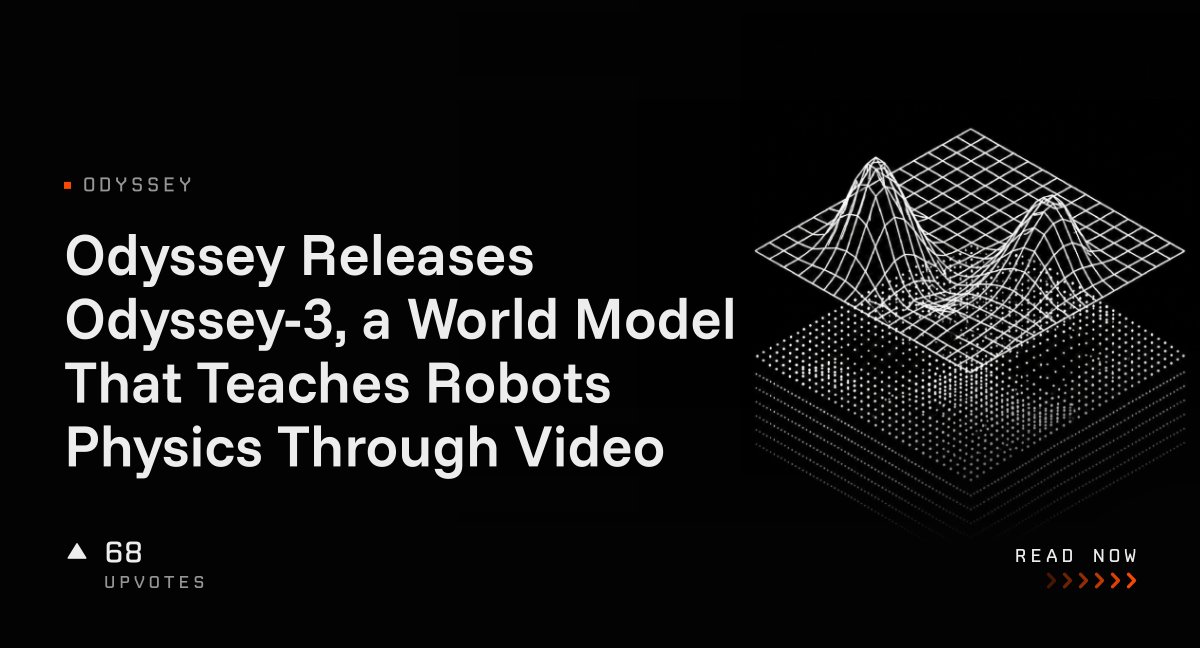
Odyssey has introduced Odyssey-3, an autoregressive diffusion transformer designed as a real-time interactive foundation world model. The system generates navigable environments from text prompts and predicts scene changes based on agent actions. To minimize latency, Odyssey compressed the original multi-step video diffusion sampler into a few-step model using distribution-matching distillation, generative adversarial discriminators, and reinforcement learning. The model's base architecture utilizes temporal rotary positional embeddings and causal masking to predict subsequent states from past observations.
In evaluations, Odyssey-3 Pro achieved a score of 66.1 on the Physics-IQ Verified video-to-video benchmark using best-of-eight sampling at 720p, representing the highest reported score to date. The model also ranked first in three out of four WorldMark categories, though it placed third in first-person real environments with a score behind Lyra 2.0 at 84.4 and AlayaWorld at 83.0. Odyssey trained the model on three distinct data streams: annotated internet videos, gameplay recordings with synchronized keyboard and mouse inputs, and captioned rigid-body simulations.
For robotics practitioners, the primary advantage of Odyssey-3 is its reusable, frozen visual backbone. By training a smaller action decoder or policy on top of this frozen backbone, developers can adapt the model to physical systems with minimal data. For example, Odyssey trained a closed-loop driving policy to navigate a car in India using only 20 hours of road data. Similarly, robot arms trained on tens of hours of demonstrations successfully completed manipulation tasks and recovered from unscripted failures, while Flexion used the model to build humanoid policies that outperformed existing vision-language-action baselines under changing environmental conditions.
The model is currently available as a free research preview at experience.odyssey.systems, and developers can request API access for physical control systems. While the model promises to lower adaptation costs, practitioners should note that Odyssey has not yet published specific API pricing, hardware-specific latency, or exact frame rates. Furthermore, independent testing is still required to verify the model's safety, reliability, and sim-to-real transfer capabilities across unfamiliar hardware.
This is our own summary of reporting by AlphaSignal