Perplexity integrates GPT-5.6 Terra and Luna models
Perplexity has integrated OpenAI's GPT-5.6 Terra and Luna models into its Perplexity Computer platform, significantly boosting agentic performance while slashing operational costs.
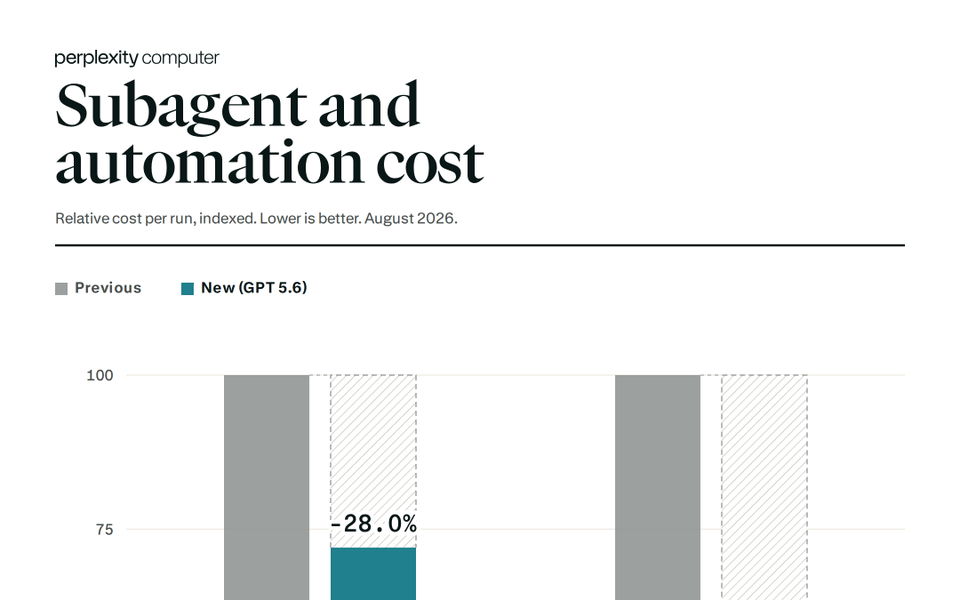
Perplexity has updated its agentic platform, Perplexity Computer, by integrating two new models from OpenAI's GPT-5.6 family: Terra and Luna. GPT-5.6 Terra now serves as the default subagent and an optional orchestrator, while GPT-5.6 Luna is tasked with managing scheduled automations. These models join a meta-orchestration architecture launched in early 2026 that breaks down complex prompts and routes sub-tasks across more than 20 frontier models running asynchronously in an isolated cloud sandbox. Both models are immediately available to Pro and Max subscribers without requiring any manual configuration.
This update introduces a highly efficient pricing structure for developers and enterprise users. GPT-5.6 Luna is positioned as the most affordable tier, priced at $1 per million input tokens and $6 per million output tokens. GPT-5.6 Terra costs $2.50 per million input tokens and $15 per million output tokens, which is half the cost of the flagship GPT-5.6 Sol model priced at $5 per million input tokens and $30 per million output tokens. Despite the price differences, all three models in this generation feature a massive 1 million token context window and support up to 128,000 maximum output tokens.
For AI practitioners, this integration delivers a substantial performance boost at a fraction of the cost. On Perplexity's own open-source WANDR research benchmark, which evaluates systems on 500 evidence-backed wide research tasks, Terra scored 11 points higher than Anthropic's Claude Sonnet. The difficulty of this benchmark is highlighted by the fact that the top-performing system, Perplexity's own, achieved a soft F1 score of just 0.363. By swapping in these specialized models, practitioners can now deploy highly complex, multi-step agentic workflows that are both financially viable and capable of handling long-context reasoning tasks with greater accuracy.
This is our own summary of reporting by AlphaSignal