Spotify uses Honk AI agent to rewrite its codebase
Spotify developed an internal AI coding agent called Honk to automate complex codebase migrations, dramatically accelerating software maintenance across thousands of repositories.
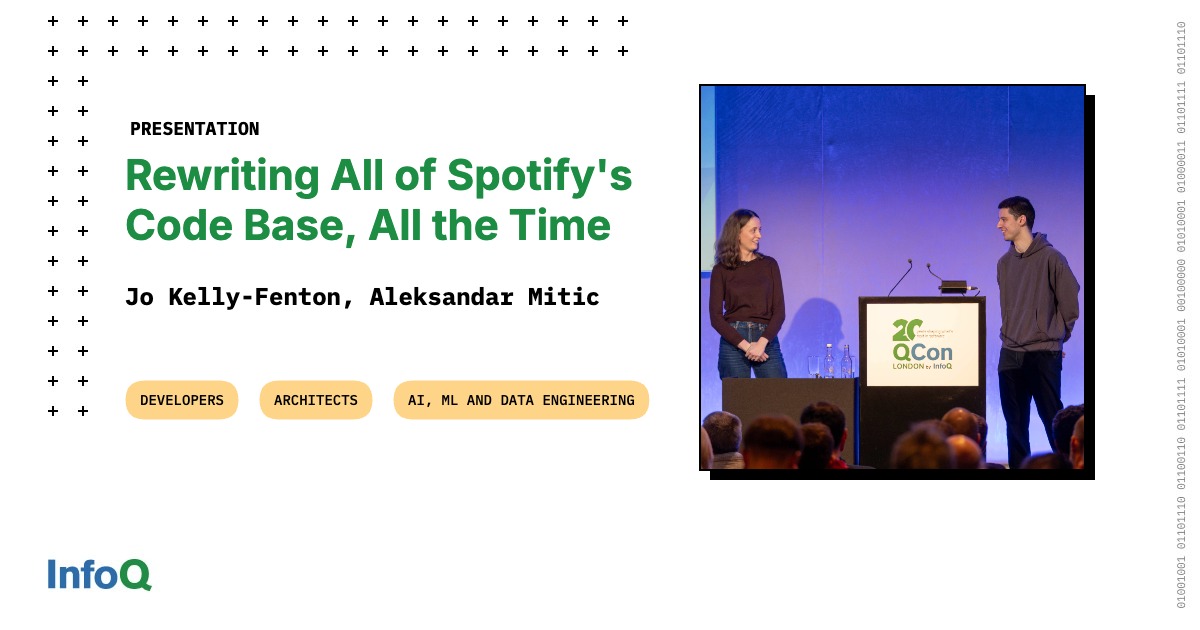
Spotify engineers Jo Kelly-Fenton and Aleksandar Mitic recently detailed how the company built Honk, an autonomous coding agent designed to tackle the "maintenance problem." On average, developers spend less than one hour per day writing new code, with the rest consumed by meetings and routine tasks like upgrading dependencies. While Spotify's pre-LLM fleet management system reduced the time to deploy library updates to 70 percent of the fleet from almost a year to just under a week, the remaining 30 percent of complex, edge-case codebases required manual intervention. Honk was created to automate this difficult long tail.
To make Honk work across thousands of repositories, Spotify decoupled the agent's runtime from its verification runtime. The system uses a unified verification tool that interfaces with various build systems, including Maven, Yarn, and Bazel. When builds fail, Honk uses an LLM to summarize the massive error logs. Initially, the team used an LLM-as-a-judge to block incorrect changes, such as downgrading Java versions or deleting tests. However, as LLM capabilities improved, they removed the judge and embedded verification steps directly into prompts. To avoid infrastructure issues like missing Docker permissions or iOS build limitations on local virtual machines, Spotify routed Honk's final checks through its actual continuous integration (CI) system before generating pull requests (PRs).
The agent's impact has grown exponentially. Originally a command-line tool for platform migrations, Honk's adoption surged after an engineer integrated it with Slack during a Hack Week. Spotify went from merging 1,000 Honk-generated PRs over three months to merging 1,000 PRs every 10 days. This massive influx of automated code has shifted the engineering bottleneck from writing code to reviewing it. Mitic referenced psychologist Lisanne Bainbridge's paper on the ironies of automation, noting that automating code generation leaves humans with the hardest task: evaluating whether a PR is safe to merge. To address this, Spotify is refining its review culture, building unified PR inboxes, and exploring auto-merging capabilities.
This is our own summary of reporting by InfoQ AI