New RL method steers generative crystal design
A new reinforcement learning method steers generative crystal design to target novel, functional materials, overcoming limitations in traditional generative AI discovery.
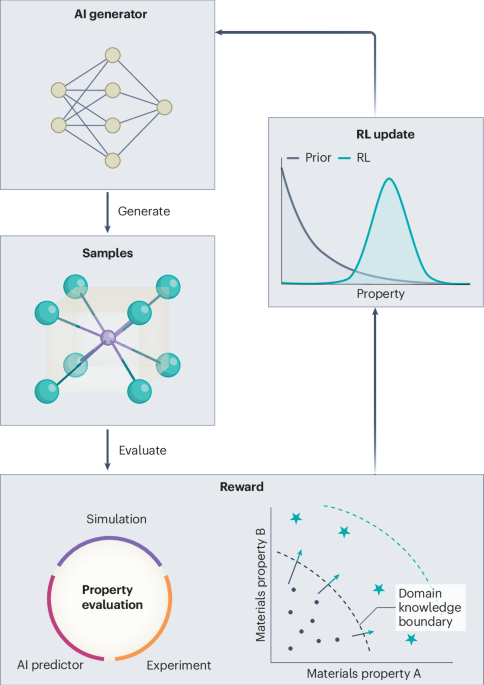
Researchers Zhendong Cao and Lei Wang from the Institute of Physics at the Chinese Academy of Sciences have highlighted a new methodological advancement where reinforcement learning is used to guide generative crystal design. Published in Nature Machine Intelligence under the DOI 10.1038/s42256-026-01282-0, this approach addresses a critical bottleneck in materials science: the inability of standard generative machine learning models to efficiently explore the vast space of potential materials to find candidates that are both entirely new and practically useful.
Traditional generative AI models have accelerated the discovery of crystal structures, but they often struggle to balance novelty with utility. They frequently generate material candidates that are either chemically unstable, impractical to synthesize, or too similar to existing structures. By introducing what the authors describe as a "reinforcement learning loop for goal-directed crystal generation," researchers can now steer the generative process toward specific target properties. This closed-loop feedback mechanism ensures that the AI focuses its search on viable, functional materials rather than generating random or useless chemical configurations.
For materials scientists and AI practitioners, this development represents a shift from passive generation to active, goal-oriented design. Instead of filtering through thousands of unviable AI-generated structures, researchers can use reinforcement learning to reward the model for producing crystals with desired physical properties, such as specific electronic, magnetic, or structural traits. This targeted exploration significantly reduces computational waste and accelerates the pipeline from algorithmic design to laboratory synthesis.
This research builds upon a rapidly growing body of literature at the intersection of AI and chemistry, referencing foundational work from 2022 to early 2026 by researchers such as Park and Walsh, Zeni, and Batatia. By refining how generative models navigate complex chemical spaces, the integration of reinforcement learning paves the way for the automated discovery of next-generation semiconductors, catalysts, and energy storage materials.
This is our own summary of reporting by Nature Machine Learning