Vercel Labs launches Zero to let AI agents write code
Vercel Labs has released Zero, an experimental systems programming language designed specifically for AI agents to write, compile, and repair code using a graph-first architecture.
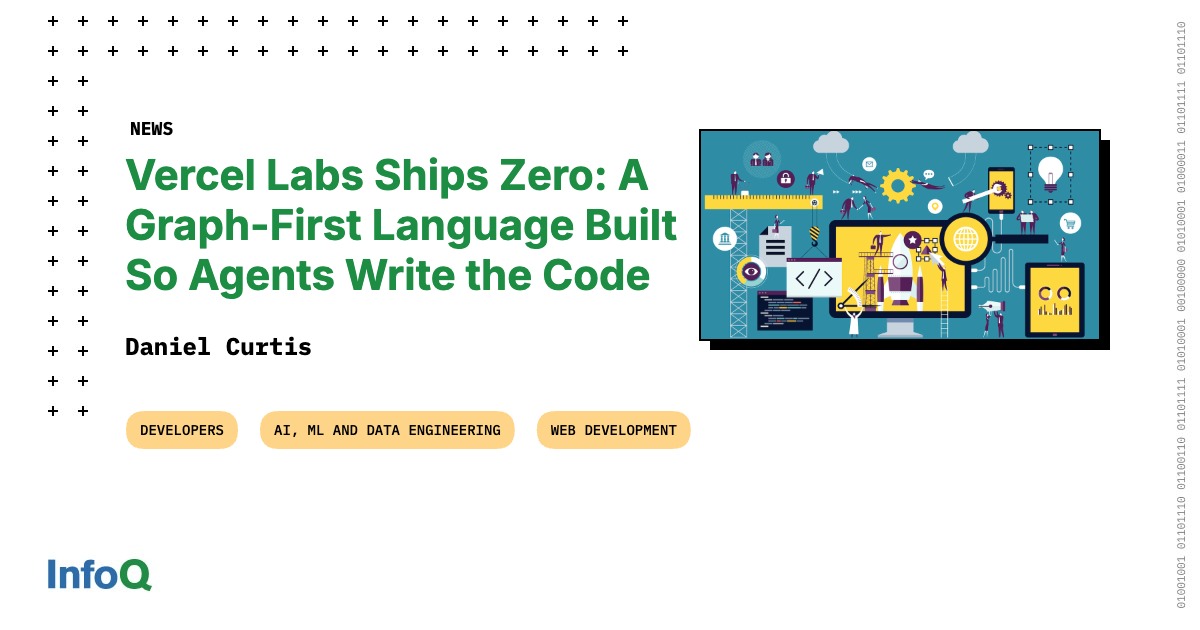
Vercel Labs has introduced Zero, an experimental systems programming language built on the premise that AI agents, rather than humans, are now the primary consumers of compiler output. Originally pitched by Vercel's Chris Tate on May 15, 2026, the Apache 2.0-licensed project has quickly progressed to version 0.3.4 and amassed over 5,200 stars on GitHub. Compiling to native binaries for Linux, macOS, and Windows, Zero boasts impressive performance metrics, with a basic 'hello world' program compiling in a single millisecond to a tiny 16.2 KiB binary.
The language's toolchain is optimized for machine interaction. Every subcommand of the single zero binary supports a --json flag and shares a unified diagnostic schema. This allows the compiler to return stable error codes like NAM003 alongside typed repair metadata such as declare-missing-symbol. Instead of applying blind fixes, agents can run zero fix --plan --json to receive a structured, machine-readable repair plan to accept, edit, or reject. Additionally, Zero enforces explicit side effects by requiring any function interacting with the network, filesystem, or standard output to accept a World capability.
A major paradigm shift occurred in version 0.3.0, which established graph-first authoring as the default workflow. The compiler now takes a binary zero.graph store as input, while traditional .0 files serve merely as human-readable projections. Agents manipulate code using zero query and zero patch, with edits secured by graph hashes to prevent stale writes. This transition has caused some churn; version 0.1.4 introduced row syntax, version 0.2.0 made canonical .0 text the native source surface, and version 0.3.0 stopped accepting source projections directly. To ease this, developers must use zero import to ingest text packages, a process made roughly 12x faster for large programs in version 0.3.2.
For software architects, Zero offers a unique middle ground among systems languages. It aligns closer to Zig than Rust regarding binary size and explicit allocation, though it lacks Rust's mature ecosystem and borrow checker. It also eschews Go's green threads and larger runtime in favor of self-contained, lightweight artifacts. Because the language is highly experimental and prone to breaking changes, Vercel Labs advises developers to run Zero in isolated workspaces rather than production environments.
This is our own summary of reporting by InfoQ AI