OpenAI launches GPT-5.6 and drops ChatGPT limits
OpenAI has eliminated text chat limits for free ChatGPT users and launched its GPT-5.6 Luna and Sol models, a major upgrade that introduces adjustable reasoning and fewer factual errors.

OpenAI has announced the removal of text-based chat limits for all ChatGPT users, a service that recently surpassed one billion weekly users. This transition introduces the new GPT-5.6 Luna model as the default engine for Free and Go tier users, replacing the older GPT-5.5 model. While text conversations are now unrestricted, OpenAI will maintain existing caps on other modalities, including file uploads, voice interactions, and image generation.
Alongside the model upgrade, Free and Go users will receive a new "Think" button designed to trigger deeper reasoning capabilities for complicated queries. Meanwhile, paying Plus and Pro subscribers are gaining access to an updated version of the GPT-5.6 Sol model, which is optimized to deliver concise and robust responses for tasks like planning, writing, and web research. This specific Sol variant is distinct from the version used for Codex and Work. Plus and Pro subscribers also get a "thinking slider" to manually control the depth of reasoning the model applies to a prompt.
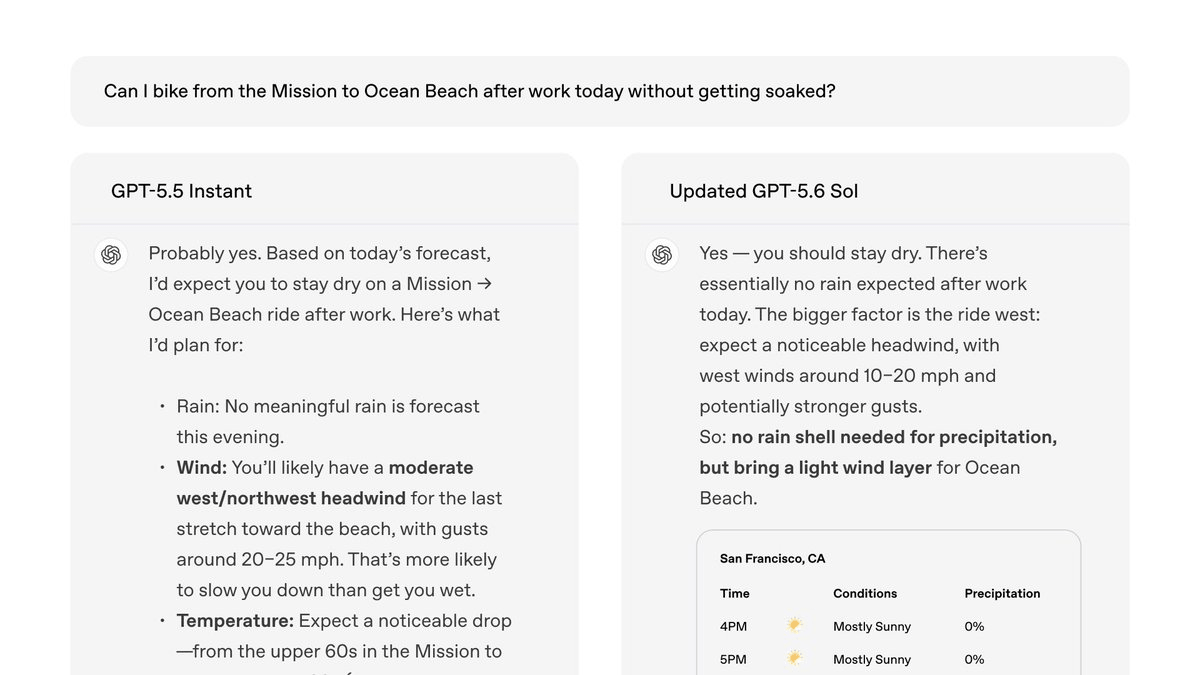
According to OpenAI's internal evaluations, these new models represent a major leap in accuracy. Factual errors have dropped by 62 percent for GPT-5.6 Luna and 68 percent for GPT-5.6 Sol when compared to the older GPT-5.5-Instant model. The rollout of these updates is staggered: Plus and Pro members can access the updated GPT-5.6 Sol immediately, while Free and Go users will see initial changes this week, followed by unlimited text chats and the "Think" button next week.
For AI practitioners and developers, these updates lower the barrier to entry for high-quality prototyping and testing. The dramatic reduction in factual errors across both Luna and Sol means that even free-tier integrations and workflows will suffer far less from hallucinations. Furthermore, the introduction of the thinking slider and button allows users to optimize compute costs and latency, choosing between rapid-fire responses for simple tasks and deep-reasoning cycles for complex problem-solving.
This is our own summary of reporting by TechCrunch AI