Claude Fable 5 beats GPT-5.6 on coding benchmark
Claude Fable 5 has dominated Epoch's MirrorCode benchmark with a 64% solve rate, crushing GPT-5.6 Sol's 20% and signaling a major leap forward in long-horizon autonomous software engineering.
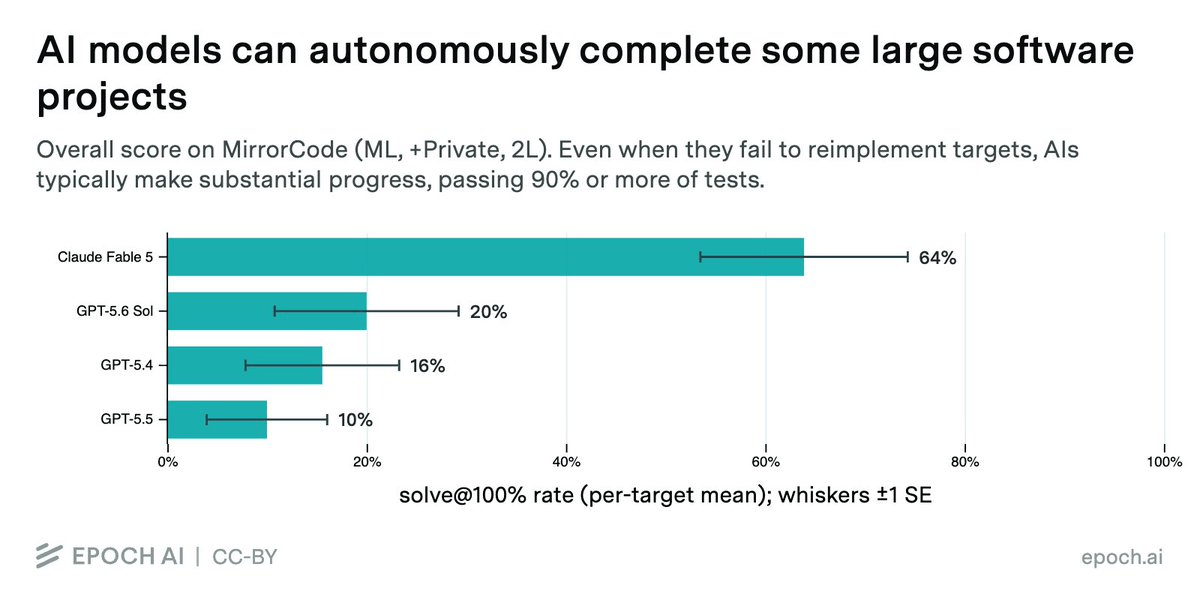
Epoch AI has updated its MirrorCode benchmark leaderboard, revealing that Claude Fable 5 achieved a dominant 64% solve rate. This performance vastly outpaced its closest competitor, GPT-5.6 Sol, which scored 20%. Other models trailed further behind, with GPT-5.4 reaching 16% and GPT-5.5 landing at 10%. MirrorCode, co-developed with and supported by METR, is a rigorous long-horizon software engineering benchmark that requires AI agents to fully reconstruct command-line interface programs from scratch using only a compiled, execute-only binary, text documentation, and visible test cases. To succeed, an agent must pass 100% of both visible and hidden end-to-end tests with no partial credit.
The benchmark allows for massive inference budgets, providing up to 10 billion tokens per attempt. This contrasts sharply with traditional coding benchmarks that cap spending at a few dollars. On MirrorCode, attempting one of the most difficult tasks required a single run lasting 19 days and costing $2,600. Despite these extreme demands, Claude Fable 5 became the first model to successfully solve the C preprocessor and Pkl tasks, which had consistently defeated previous generations of AI. Furthermore, frontier models demonstrated comparable proficiency when writing in the niche language Ada versus the widely used Go, hinting at a generalized capacity for programming logic rather than rote syntax recall.
For software engineering practitioners, these results signal a transition from simple code-completion assistants to truly autonomous agents capable of complex system architecture. Instead of merely fixing bugs or writing isolated functions, agents can now reverse-engineer legacy systems and build complete, functional software from black-box specifications. Developers looking to explore these capabilities can access the benchmark directly, as the paper is published on arXiv, and the full scaffold along with 22 of the 25 target programs are open-source on GitHub.
This is our own summary of reporting by AlphaSignal