DeepSeek releases 304B-parameter model
DeepSeek has launched DeepSeek-V4-Flash-0731, a 304-billion-parameter model that offers industry-leading cost efficiency and advanced agentic capabilities for developers.
DeepSeek has expanded its V4 model family with the release of deepseek-ai/DeepSeek-V4-Flash-0731. This new model features 304 billion parameters and is available as a 167GB download on Hugging Face. Designed to deliver what the creators describe as substantially enhanced agentic capabilities, the model is positioning itself as a highly competitive option in the landscape of large language models, particularly when balancing performance against operational costs.
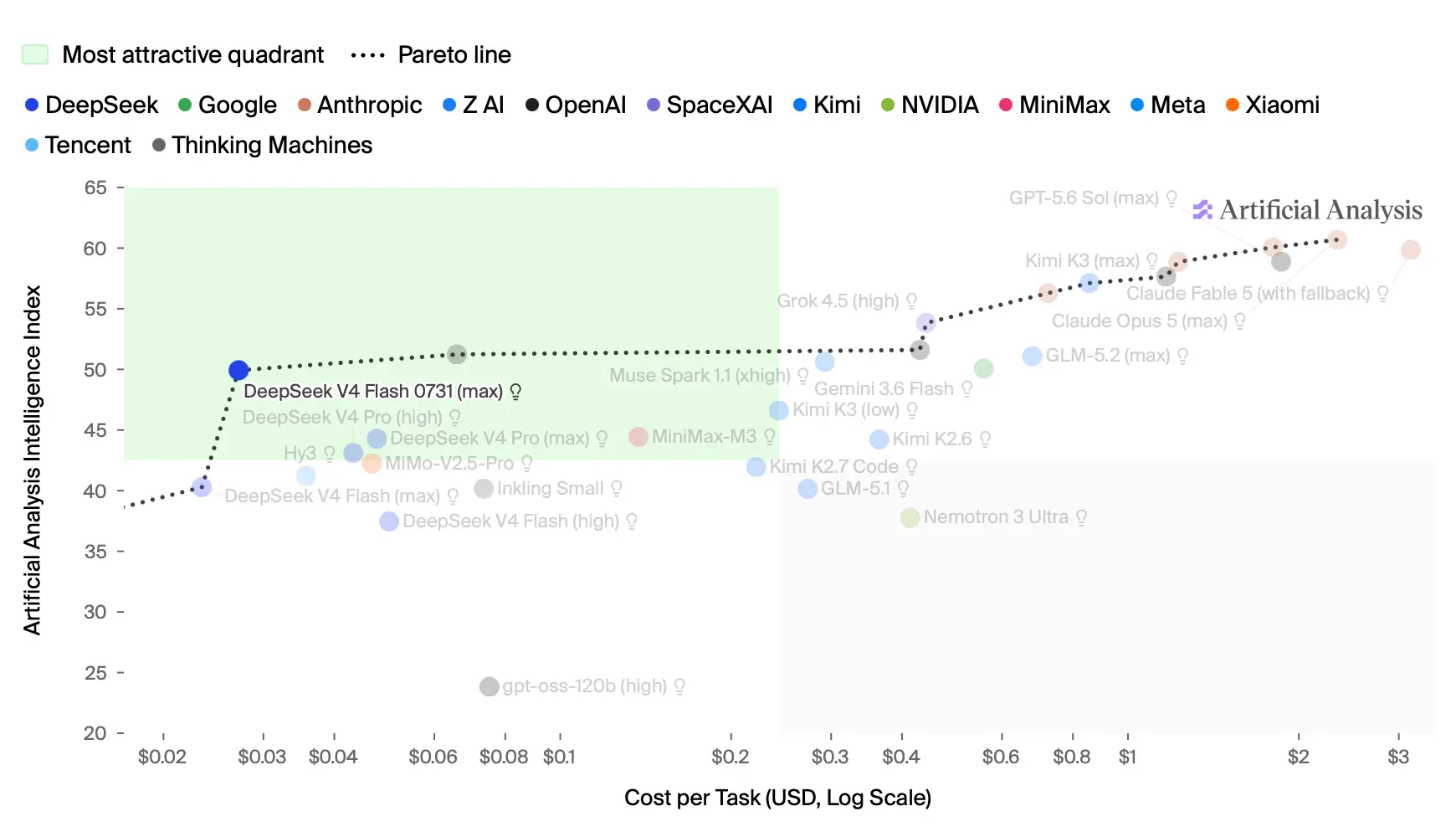
In terms of raw efficiency, the model is already turning heads. Evaluation platform Artificial Analysis ranks the new DeepSeek model ahead of MiniMax M3, which is a larger 428-billion-parameter model. This performance is paired with highly aggressive pricing: it costs just $0.14 per million input tokens and $0.27 per million output tokens. These figures place the model in a prime position on the Intelligence Index versus Cost per Intelligence Index Task chart, making it arguably the best value-per-intelligence model currently available to developers.
For AI practitioners, this release represents a major shift in the cost-to-performance ratio for deploying agentic workflows. However, unlocking the model's full potential requires some tactical adjustments. Early testing via OpenRouter indicates that the default reasoning level may produce underwhelming outputs, such as a poorly rendered pelican graphic. By explicitly increasing the reasoning effort to high, using the parameter reasoning_effort set to high, the model's output quality improves dramatically.
This flexibility allows developers to dynamically scale computational resources and costs based on task complexity. By offering high-tier intelligence at a fraction of the cost of larger competitors, DeepSeek-V4-Flash-0731 lowers the barrier to entry for complex agentic applications, proving that parameter efficiency and smart pricing can challenge the dominance of much larger systems.
This is our own summary of reporting by Simon Willison